
Skid Roads of North Vancouver

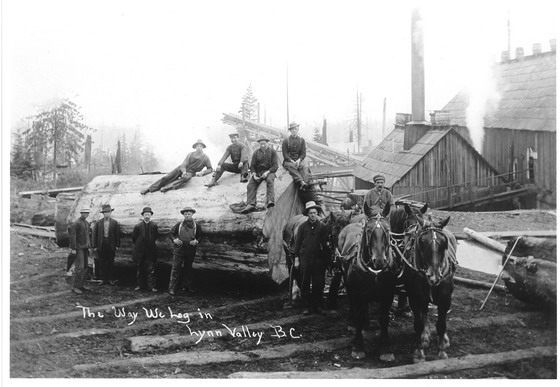
Ever wonder about the history of the forests around Vancouver, BC, Canada? Next time you visit Enfor's office you could be driving on historical forest roads used 130 years ago. Maybe check the big notched cedar stump in the little park beside our office for insight into forest history. You will see these notched stumps all over the forests of Vancouver.
The first roads in North Vancouver were built for the logging industry. The first commercial skid road was built in 1873 to convey tree trunks (often over 160 feet long) to both Moodyville Sawmill (opened 1862) on the North Shore and to Hastings Mill (opened 1867) in Vancouver at the foot of Dunlevy Street on the south shore of Burrard Inlet. Several skid roads were already in use when the District of North Vancouver was incorporated in 1891. Keith Road, the first civic road, was initiated only after incorporation.
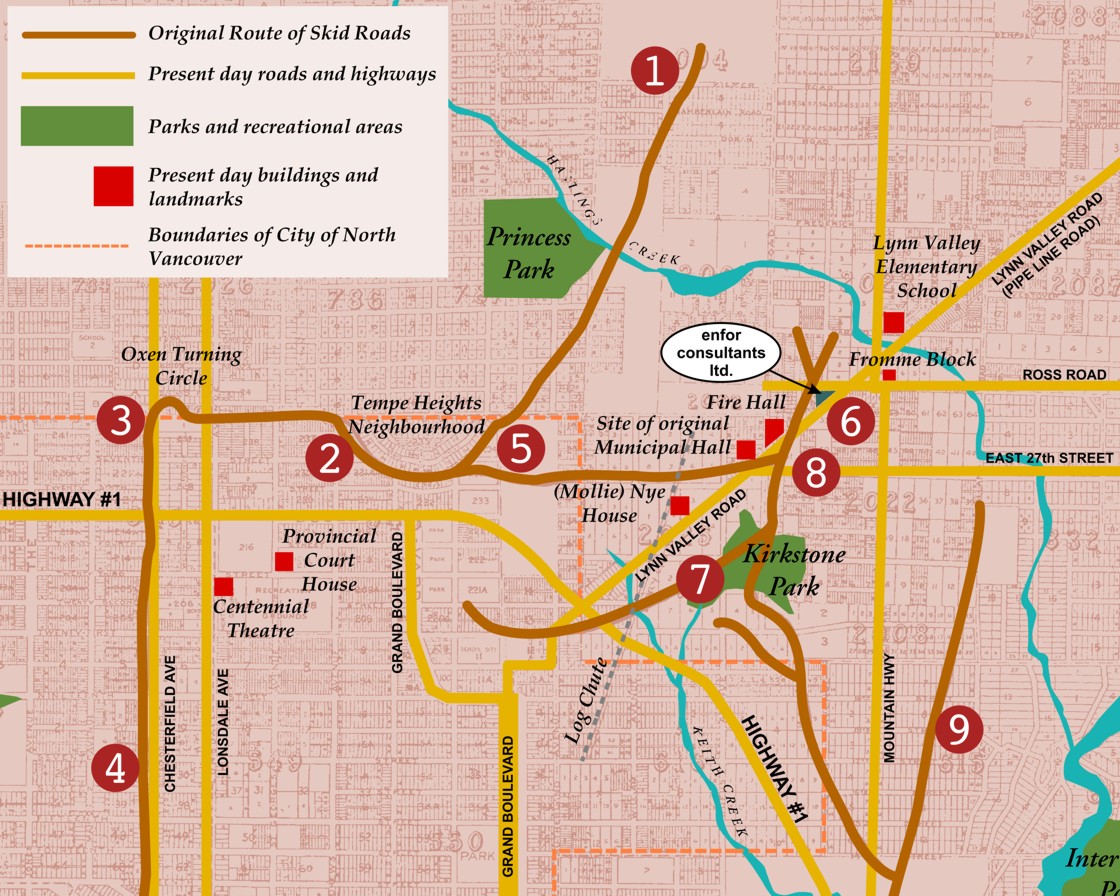
Long before commercial logging commenced as a local business in Lynn Valley in 1885 (once called Shake Town), logs were being harvested here and transported to the shore of Burrard Inlet by way of the routes shown on the adjacent map.
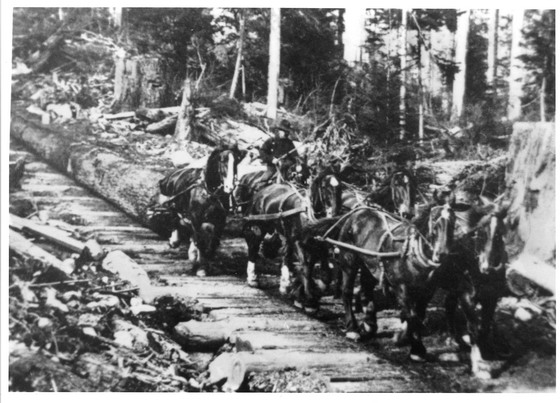
At first, logs were felled from the water's edge. Later, skid roads were constructed to haul the logs out of the forest. The skid roads used heavy logs, eight feet long and positioned perpendicular to the road's direction. Down the centre of the road was a "U" shaped notch hewn out with axes to rough the contour of a 12-foot diameter log, and greased with fish oil. This was applied to allow the approximately 160-foot long log, cut into three parts, spiked and chained together, to be towed by teams of eight pairs of oxen.
One skid road route commenced near the Dempsey stone quarry
 on the west side of Centre Road (Mountain Highway)
in Upper Lynn Valley. It passed through what later became Princess Park, continuing up to 29th Street
(known in 1907 as Boundary Road). The skid road then followed around Tempe Crescent
on the west side of Centre Road (Mountain Highway)
in Upper Lynn Valley. It passed through what later became Princess Park, continuing up to 29th Street
(known in 1907 as Boundary Road). The skid road then followed around Tempe Crescent
 south of the 29th Street hill on the west side of what is now Lonsdale Avenue. Here there was a wide turning circle from 29th
Street on to Chesterfield Avenue
south of the 29th Street hill on the west side of what is now Lonsdale Avenue. Here there was a wide turning circle from 29th
Street on to Chesterfield Avenue
 to allow a 16 oxen team towing 160-foot long tree trunks in three inline
sections, to turn south
to allow a 16 oxen team towing 160-foot long tree trunks in three inline
sections, to turn south
 down to Burrard Inlet. Once in the water the logs were towed by steam tug to the mills.
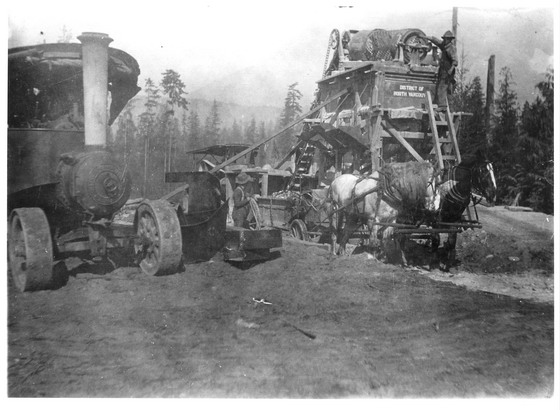
The skid road branch
 came from the south-east side of Tempe Crescent (presently located by steps and paved
footpath leading down into Tempe Heights subdivision). As late as the 1920's the local children could hear
the "chuff chuff" of the steam donkey engine hauling logs at the foot of this slope and see its sparks
and smoke long after dark.
came from the south-east side of Tempe Crescent (presently located by steps and paved
footpath leading down into Tempe Heights subdivision). As late as the 1920's the local children could hear
the "chuff chuff" of the steam donkey engine hauling logs at the foot of this slope and see its sparks
and smoke long after dark.
The skid road linked in 1903 with a feeder road coming down from the area of Harold and another from the
south-west. All then proceeded south
 down Fromme Road/27th Street angling down to join the skid road
continuation of
down Fromme Road/27th Street angling down to join the skid road
continuation of
 Allen Road (which was built around
 1903 for the Hastings Shingle Manufacturing Company
owned
1903 for the Hastings Shingle Manufacturing Company
owned
 by James and Robert Mcnair of Vancouver). The 1875 and 1903 skid roads met just east of the "Dog Leg"
on Mountain Highway at 14th Street and the resulting single skid road continued on the south side of the
curve of Heywood Street to Moodyville mill site and the waterfront.
by James and Robert Mcnair of Vancouver). The 1875 and 1903 skid roads met just east of the "Dog Leg"
on Mountain Highway at 14th Street and the resulting single skid road continued on the south side of the
curve of Heywood Street to Moodyville mill site and the waterfront.
Roy J. V. Pallant, MA
Source: A community contribution from the Adera Group of Companies, for the District of North Vancouver, 1999 (posted in Lynn Valley, North Vancouver, BC).
Dempsey Quarry
Skid Road
Log Hauling Donkey Engine
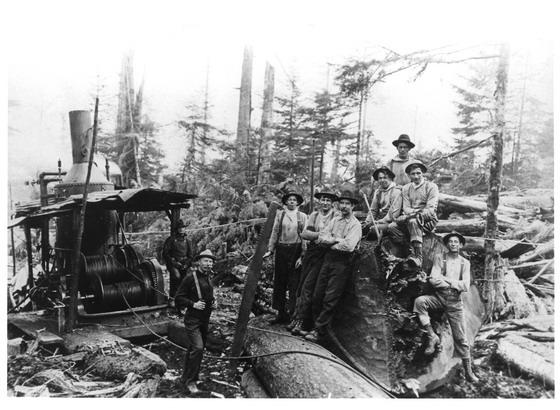
Upper Mill (Mill Street)
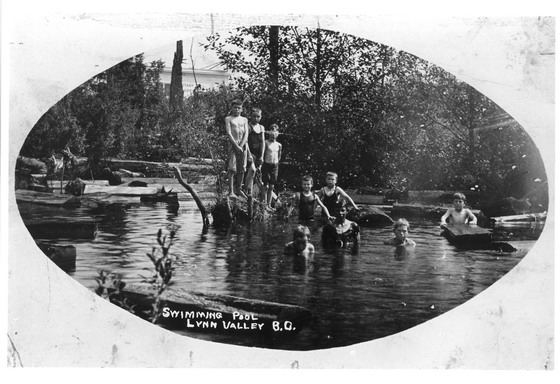
Hastings Lower Mill Pond
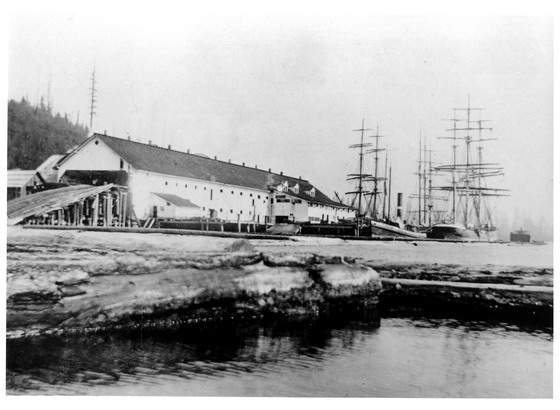
Mill at Moodyville
For more about logging in the early 20th century on coastal BC, Canada, please see the Youtube video kindly prepared by Allison Logging Coastal Logging in the early 20th Century
Thank you for your interest in forest history. If you have any photos or stories you'd like to share, please feel free to contact us. Mike Greig, a forester and principal at Enfor, would be pleased to talk with you.
For more forest history of BC, visit: https://fhabc.org/